Climate Change & Federal Aid Disbursements
Overview
This was an interdisciplinary effort to assess the relationship between climate change attributable damages and federal disaster assistance.
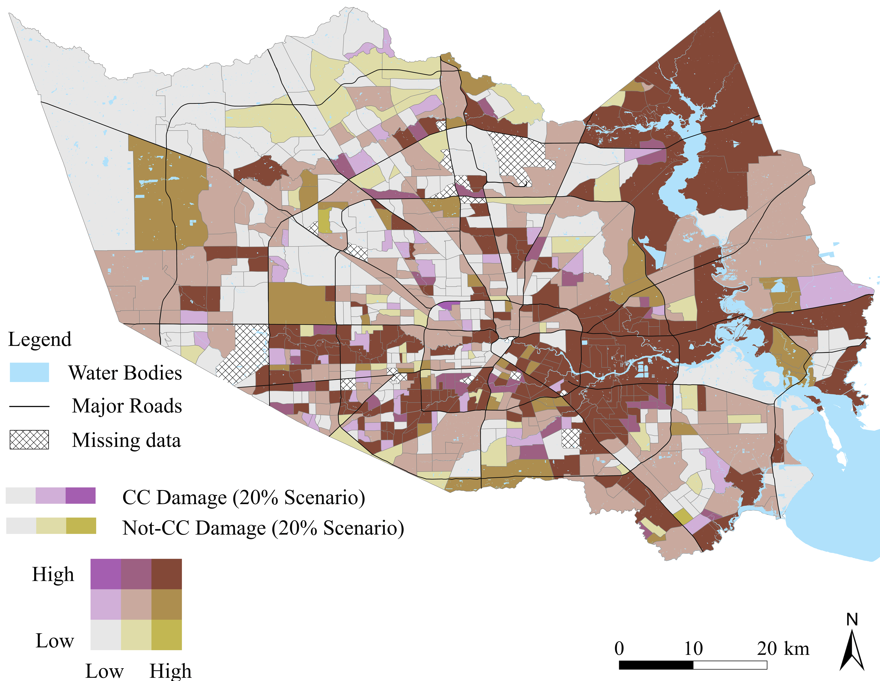
I integrated modeled flood damages with FEMA NFIP paid claims and Individual Assistance payouts, applied spatial lag regression models to estimate both direct and spatial spillover effects of attributable damages, and created maps to visualize the relationship.
Results indicate that while both attributable and non-attributable flood damages were associated with federal aid, climate change attributable damages generally had larger effect sizes, particularly for Individual Assistance.
My Role & Contributions
Led the data analysis and wrote the first draft of the manuscript, including building the census tract–level dataset, running spatial diagnostics and regression models, and producing the descriptive statistics and maps.
Data
Attributed flood damage: Building-level flood simulations comparing Harvey’s observed rainfall to counterfactual storms without climate change under two attribution scenarios (20% and 38% of rainfall attributed to climate change). Damage was aggregated to tracts and split into damage attributable and not attributable to climate change.
Federal aid: OpenFEMA claims data for the National Flood Insurance Program (NFIP) and Individual Assistance (IA) home repair grants.
Socioeocnomic Characteristics: American Community Survey 5-year estimates (via NHGIS), NFIP policy counts, and the share of homes in the FEMA 100-year floodplain.
Key Findings
Climate change made flooding much more costly. It added 20–38% more rain, but accounted for roughly 35–53% of the damage.
More climate change attributable damage meant more federal aid. Neighborhoods with more damage from climate change received larger payouts from both flood insurance (NFIP) and FEMA home repair grants (IA).